Compromise on Home Decor When You and Your Partner Disagree


Ever tried to decorate your home only to find your partner doesn’t share your vision? Decorating together can feel like solving a Rubik’s Cube—blindfolded. If you’ve ever been paralyzed by “We can’t agree so we don’t do anything” syndrome, these practical tips will help you move forward together and create a space both of you can love.

Balancing different tastes—whether with a spouse, roommate, or family member—can create tension. It’s often not the paint color or the TV placement that trips people up, but the feeling of being unheard. Below are realistic strategies we’ve used in our home to compromise without sacrificing style.
I’m not a relationship expert, but I will share how my husband (affectionately called Pookie) and I handle design disagreements. We’ve found a few simple rules that keep arguments rare and progress steady.
Tip #1: Neither one of you can always be the chief
Early in our marriage we learned that someone needs final decision authority; otherwise you either do nothing or one person feels resentful. The key is a fair, agreed-upon division of responsibility based on passions and priorities.
For example, we decided that Pookie gets more say over cars, the yard, and exterior projects, while I take the lead on interior decisions. We quantify it as roughly 60/40 when a strong preference exists. That gives each of us room to lead in the areas we care about most while still respecting the other’s voice.
Pookie: I know Suzy cares more about interiors, so I defer to her in that area. I have opinions, but my real passion is cars and outdoor projects.
Tip #2: Be respectful of one another
Disagreements easily escalate when feelings take over. Remember that a different taste doesn’t mean the other person is wrong. Try not to personalize preferences and avoid blaming language. When tempers rise, step away and revisit the discussion after you’ve cooled down—sometimes a few hours or a couple of days makes all the difference.
Pookie: When we both feel strongly, we’ll table the conversation and return later. It helps us approach the issue more calmly and constructively.
Suzy: It took practice. We weren’t perfect at first, but we got much better at listening and giving each other space.
Tip #3: Recognize natural differences in approach
Men and women often communicate and make decisions differently—that’s a generalization, but it can explain some recurring clashes. One of us might focus on function, cost, and engineering, while the other emphasizes aesthetics and mood. Acknowledging these tendencies makes it easier to translate opinions into compromise rather than conflict.

Pookie: I care about cost and function. My tastes lean minimalist and rugged—wood, stone, leather. No throw pillows, please.
Suzy: I want spaces to feel beautiful and layered. The trick is finding the balance between those instincts.
Blending masculine and feminine tastes takes patience and a plan—see Tip #6 for practical ways to merge both styles.
Tip #4: Be patient
Don’t rush a decision. Visual references like photos and inspiration boards help more than abstract descriptions. Your partner can’t read your mind; showing examples makes your intent clear. Give the other person time to consider the idea and live with samples when appropriate—paint swatches, fabric scraps, or furniture layouts.

Pookie: I see fewer color options in my head—gray is gray—but sampling and living with colors helps find a consensus. We often try paint chips on the wall for days or weeks until one feels right.
Suzy: We once lived with huge paint samples on a wall until we landed on a warm beige with gray undertones. Compromise doesn’t mean giving up your vision—it means adapting it so both of you feel comfortable.
Tip #5: What if you really can’t agree?
First, revisit the earlier tips: decide who has final say in which areas, respect one another, and remember natural differences in approach. Have general conversations about decision-making before you start any specific project so you both know the rules of engagement.
When disagreements persist, focus on practical concerns—budget, maintenance, and function—so choices aren’t purely emotional. If one person wins on a small detail, the other should feel heard and allowed to add a meaningful personal touch elsewhere.
Pookie: I point out costs and practicality when I disagree. I don’t design like Suzy does, but I try to make my perspective useful rather than obstructive. And ultimately, we honor our interior/exterior agreement so both of us get to lead sometimes.
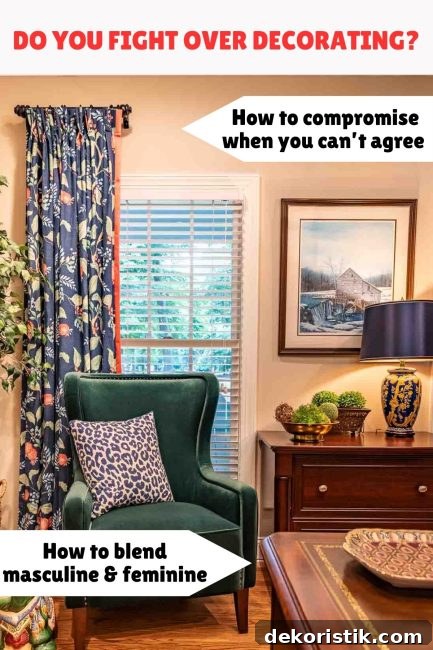
Tip #6: How to blend masculine and feminine decorating styles

Combining both styles takes finesse. Here are practical steps that helped us design a home office that feels masculine and elegant at once:
- Identify sticking points: go through your items together and vote to keep, discard, or rethink them. You’ll often uncover shared preferences.
- Start with a neutral base: paint walls and choose large furniture in neutral tones, then introduce two or three accent colors you both like.
- Avoid gender-specific décor overload: mix textures and objects so the room isn’t dominated by one person’s style.
- Keep the eye moving: distribute visual interest around the room so no single object draws all attention.
- Balance details: aim for one masculine piece for every feminine piece to maintain equilibrium.
We used these strategies in our office, and the result is a room that feels cohesive and comfortable for both of us. We aren’t perfect, but the 60/40 agreements and a commitment to respect have made decorating together enjoyable rather than stressful.
How do you handle decorating disagreements in your home? Share your best tips and compromises—you might help someone else take the first step toward harmony.